Showing posts with label 2011 PW Best Books. Show all posts
Saturday, March 23, 2013
Freedom - by Jonathan Franzen
The main character of this large book appears to be Patty Berglund. Her husband Walter figures prominently as well, as do several other characters. But Patty is the only one who gets to write portions of her own "autobiography", oddly in the third person.
Patty was an athletic young girl who got knocked off the track to a basketball career when she injured her knee. She changed her dreams, married Walter, had children, did her best to become a super housewife. She knew all along that she was not as nice as others thought she was, but there was much she did not know about herself.
Patty was originally attracted to Walter's best friend, Richard Katz. Katz was a musician, womanizer, who initially did not respond to Patty's hints. Patty, however, found herself increasingly attracted to Walter anyway. Walter was almost an anti-Richard. Thin, geeky, an environmentalist. Something in him, though, responded to something in Patty, the ex-athlete who was not much aware of the environment.
We follow Patty and Walter through many years, dipping into the lives of their children and parents as well. Until comes a time when something has gone out of their marriage and Patty is dissatisfied in general. She has become less and less fun to be around for just about everyone. In spite of which Richard is drawn to her.
What is "freedom" in this context? The freedom to do as we please? The freedom to be away from others, to be alone? We watch as Richard continues his self-destructive life, as free as can be. We see Patty and Walter's son free himself from the nest, then later engage make some questionable choices in his career, free from interference. Patty and Walter live their own lives, essentially free of each other.
Some reviewers have called this a novel of its time, and as I think of it I can agree. In a way, it sums up life today in the US for many in the upper middle class in a way that reminds me of John Cheever. There is a lot of humor but underlying that is real warmth. Something you don't see so much in Cheever.
Labels:
2011 ALA,
2011 NYT Most Notable,
2011 PW Best Books,
Judith
Saturday, February 9, 2013
Started Early, Took My Dog - by Kate Atkinson
Kate Atkinson's novels just delight me. I get great pleasure reading them. There are books that I like but these I love.
As in the others, this novel features a range of characters, some central and some peripheral. Jackson Brodie is again featured, former detective now supposedly retired. He falls for one more case: to find out who gave birth to a woman, Hope McMaster, a woman who now lives in New Zealand but who was born in England. Jackson figures it shouldn't be that hard, considering he's already traveling. Wandering, really, not settling anywhere. Might as well look into the case while he's on the road.
Another major character is Tracy Waterhouse, former police detective, present head of security for a retail store. Tracy is an amply-built woman who has made her job her life, for the most part. She is not married, has no children. When she spots a familiar woman on the street, pulling a small child, she can guess what will happen to that child when she gets home. She confronts the woman, a drug addict Tracy had arrested when she was with the police. On the spur of the moment she does something highly unusual and unexpected, which changes the course of her life.
When Jackson starts to hunt down birth and adoption records he runs into a blank wall. The presumed birth parents do not appear to exist. So who really did give birth to Hope?
There are other minor characters whose lives are intertwined with these and whose actions surprise and delight at times. It's like a full, satisfying meal that left me feeling just right.
Saturday, December 29, 2012
State of Wonder. by Ann Patchett
Ah, to have another novel with the same sense of wonder as Bel Canto! And even named "State of Wonder" to boot.
Dr. Marina Singh, employed by a pharmaceutical company, follows fellow scientist Anders Eckman into the Amazon at the behest of her boss (and lover), Mr. Fox. Mr. Fox had received a letter from a field scientist, Dr. Swenson, saying that Eckman, who had come to urge her to provide more frequent reports of her progress, had gotten a fever and died there. Swenson's work is part of an effort to develop a fertility drug for the pharmaceutical company.
There are complications. Not least of them is the fact that Swenson is notoriously difficult to find and to persuade. She wants to do things her way and not be hurried or harassed. She has a young couple set up in her "town" apartment whose main job is to divert those who are interested in meeting with Swenson.
Marina was chosen in large part because she was a student of Swenson's years ago. Supposedly she knows how to get through to her. Marina is not so sure but allows herself to be persuaded to go. The main reason she decides to go is that Eckman's wife wants to be absolutely certain that her husband is dead. She wants Marina to find proof. She prefers to believe that he is still alive until she is given that proof.
The first many days in the little town are spent trying to connect to Dr. Swenson. When she is finally successful she follows the good doctor into the Amazon, on her boat. There she is soon absorbed by Swenson's work and by meeting and learning about the natives.
Marina's character is caring and giving, and also very human. It is easy to relate to her and to want the most for her and even to want her affair with "Mr. Fox" to go well in spite of the large difference in their ages (Fox is many years older.) There is a warmth and kindness not only in Marina but in many of the other characters as well, even, to some extent, the unyielding Dr. Swenson. Is it this that attracted me to this book? Yes, but there is more. There is the way Marina faces her life in the Amazon, how she makes her decisions, what she actually does, that is just delightful, although that word may not seem appropriate at times. As in Bel Canto, there is unexpected pleasure throughout. What more could you want?
Monday, March 19, 2012
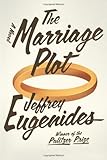
The Marriage Plot by Jeffrey Eugenides
Been a long time since I posted here, but I noticed I recently did read a Notable Book. Crossposted from Aquatique:
I have read both of Eugenides's other books: The Virgin Suicides and Middlesex. In fact, I liked the latter so much, I even own after having it seen it discounted at Chapters. I don't really buy new books often. I have enjoyed his work. It's really in the characters, prose and to a certain extent, how good Eugenides is about writing about gender and relationships. With TVS, the characters seem both real and mythical. That worked was definitely filled with nostalgia and a surreality. But it was in Middlesex in which I found him to be a very good writer. The characters in it were believable, good and real. In the Marriage Plot and in Middlesex especially, he deals with sex, gender, feminism, and these ideas in Western society. I don't mean to say he is very political about it, but he shows an understanding of these topics or the awareness of it between cultures. There's a moment in Paris where one of the main characters sees a woman (p.157):
The book is one largely about relationships, desire, unrequited love and being in love, both good and bad: "What was interesting about being the needy one was how much in love you felt" (p 25) Which isn't all about how love is, but it does describe the early rush of it and that neediness you feel to be with the other person.
Furthermore, Eugenides has touched on mental illness lightly before, but he tackles it much more in this book as one of the characters seems clinically depressed and the consequences on the other characters, both direct and indirect.
There isn't a lot of plot in Eugenides books, but it's not as slow moving as some other novels. I think like many good stories, there is actual growth or movement for all the characters, but like life, it's not perfect. The ending was sort of meta and fitting. Maybe a bit abrupt, but somewhat realistic and showed a lot of growth in all the characters.
I have read both of Eugenides's other books: The Virgin Suicides and Middlesex. In fact, I liked the latter so much, I even own after having it seen it discounted at Chapters. I don't really buy new books often. I have enjoyed his work. It's really in the characters, prose and to a certain extent, how good Eugenides is about writing about gender and relationships. With TVS, the characters seem both real and mythical. That worked was definitely filled with nostalgia and a surreality. But it was in Middlesex in which I found him to be a very good writer. The characters in it were believable, good and real. In the Marriage Plot and in Middlesex especially, he deals with sex, gender, feminism, and these ideas in Western society. I don't mean to say he is very political about it, but he shows an understanding of these topics or the awareness of it between cultures. There's a moment in Paris where one of the main characters sees a woman (p.157):
When Mitchell looked at her; the girl did an amazing thing: she looked back. She met his gaze with frank meaning. Not that she wanted to have sex with him, necessarily. Only that she was happy to acknowledge, on this late-summer evening, that he was a man and she was a woman, and if he found her attractive, that was all right with her. No American girl had ever looked at Mitchell like that.
The book is one largely about relationships, desire, unrequited love and being in love, both good and bad: "What was interesting about being the needy one was how much in love you felt" (p 25) Which isn't all about how love is, but it does describe the early rush of it and that neediness you feel to be with the other person.
Furthermore, Eugenides has touched on mental illness lightly before, but he tackles it much more in this book as one of the characters seems clinically depressed and the consequences on the other characters, both direct and indirect.
There isn't a lot of plot in Eugenides books, but it's not as slow moving as some other novels. I think like many good stories, there is actual growth or movement for all the characters, but like life, it's not perfect. The ending was sort of meta and fitting. Maybe a bit abrupt, but somewhat realistic and showed a lot of growth in all the characters.
Wednesday, February 1, 2012
The Most Dangerous Thing, by Laura Lippman
Lippman takes "thrillers" in a different direction. I don't know if it's even fair to describe this book as a member of any genre, really.
A group of five young people find each other. There are two girls and three boys, the three boys all brothers and the two girls friends. They do a lot of exploring together, and one day happen upon a shack far from anywhere, and learn that an old black man lives there. They make his acquaintance and visit him from time to time. He lives on handouts and they manage to slip food from their homes to bring to him.
One day it all changes. One of the girls, Gwen, gets together with one of the brothers, Sean, and the group breaks apart. The two take to the shed from time to time to make out, when "Chicken George" - their name for the old black man - is not there. One evening the youngest boy, Gordon, is not home for supper on time and fathers head out to look for him. They come upon Gordon and Mickey (the other girl) running from the shack, and Chicken George lying on the ground. They tell the adults that George had molested Gordon and they knocked him down.
This much we learn fairly early on.
This much the group carries around with it, as do the fathers involved. We, the readers, know there is something more, but what it is we do not know. Gordon was always a fuck-up, from an early age. He becomes an alcoholic and ultimately kills himself, and this is when it really begins. But it's not really a rerun of "The Big Chill". Chapter by chapter we get to know the different friends a bit more and we get to know little bits more about their time together and apart. And in the end we do learn the secret. I won't tell.
I had some trouble liking the characters, got a bit impatient at times, but kept reading and as the book started closing in it started to grab me. I had trouble putting it down and kept thinking about it when I was not reading it. It's really more an exploration of character than of a particular event. We can't trust Lippman to bring us out safely, which is one of the intriguing things about her.
Wednesday, November 23, 2011
PW's Best Books of 2011
The Publisher's Weekly Interactive Guide to the best books of 2011 can be found here.
PW's Top Ten Books of 2011
- The Marriage Plot by Jeffrey Eugenides
- The Devil All the Time by Donald Ray Pollock
- State of Wonder by Ann Patchett
- After the Apocalypse by Maureen McHugh
- Bossypants by Tina Fey
- Catherine the Great by Robert K. Massie
- There but for the by Ali Smith
- Hemingway's Boat by Paul Hendrickson
- One Day I Will Write About This Place by Binyavanga Wainaina
- Arguably: Essays by Christopher Hitchens
- The Marriage Plot by Jeffrey Eugenides
- The Devil All the Time by Donald Ray Pollock
- State of Wonder by Ann Patchett
- There but for the by Ali Smith
- The Wandering Falcon by Jamil Ahmad
- The Hottest Dishes of the Tartar Cuisine by Alina Bronsky, trans. by Tim Mohr
- The Sisters Brothers by Patrick DeWitt
- Say Her Name by Francisco Goldman
- Volt by Alan Heathcock
- The Stranger's Child by Alan Hollinghurst
- Train Dreams by Denis Johnson
- Changó's Beads and Two-Tone Shoes by William Kennedy
- The Night Circus by Erin Morgenstern
- The Call by Yannick Murphy
- The Tiger's Wife by Téa Obreht
- Cain by José Saramago
- Luminarium by Alex Shakar
- Someday This Will Be Funny by Lynne Tillman
- I Married You for Happiness by Lily Tuck
- Leche by R. Zamora Linmark
- The End of Everything by Megan Abbott
- Started Early, Took My Dog by Kate Atkinson
- Revenger by Rory Clements
- Hurt Machine by Reed Farrell Coleman
- A Simple Act of Violence by R.J. Ellory
- Field Gray by Philip Kerr
- The Most Dangerous Thing by Laura Lippman
- A Trick of the Light by Louise Penny
- Two for Sorrow by Nicola Upson
- After the Apocalypse by Maureen McHugh
- Zoo City by Lauren Beukes
- Triptych by J.M. Frey
- Unpossible by Daryl Gregory
- Two Worlds and In Between: The Best of Caitlín R. Kiernan, Vol. 1 by Caitlín R. Kiernan
- Erekos by A.M. Tuomala
- Bossypants by Tina Fey
- Catherine the Great by Robert K. Massie
- Hemingway's Boat by Paul Hendrickson
- One Day I Will Write About This Place by Binyavanga Wainaina
- Arguably: Essays by Christopher Hitchens
- The Convert: A Parable of Islam and America by Deborah Baker
- The Anatomy of a Moment by Javier Cercas
- The Beautiful and the Damned:A Portrait of the New India by Siddhartha Deb
- Blue Nights by Joan Didion
- Townie: A Memoir by Andre Dubus III
- The Swerve: How the World Became Modern by Stephen Greenblatt
- Life Itself: A Memoir by Roger Ebert
- A World on Fire: Britain's Crucial Role in the American Civil War by Amanda Foreman
- Tiger, Tiger by Margaux Fragoso
- Love and Capital: Karl Marx and Jenny Marx and the Birth of a Revolution by Mary Gabriel
- The Information: A History, a Theory, a Flood by James Gleick
- Blood, Bones, and Butter by Gabrielle Hamilton
- A Book of Secrets: Illegitimate Daughters, Absent Fathers by Michael Holroyd
- Rome: A Cultural, Visual, and Personal History by Robert Hughes
- In the Garden of Beasts: Love, Terror, and an American Family in Hitler's Berlin by Erik Larson
- Boomerang: Travels in the New Third World by Michael Lewis
- Malcolm X: A Life of Reinvention by Manning Marable
- Believing Is Seeing: Observations on the Mysteries of Photography by Errol Morris
- Rin Tin Tin: The Life and the Legend by Susan Orlean
- The Long Goodbye: A Memoir by Meghan O'Rourke
- The Psychopath Test by Jon Ronson
- The Price of Civilization: Reawakening American Virtue and Prosperity by Jeffrey D. Sachs
- Charles Dickens: A Life by Claire Tomalin
- The Rise and Fall of Ancient Egypt by Toby Wilkinson
- The Future of Us by Jay Asher and Carolyn Mackler
- Chime by Franny Billingsley
- Small Persons with Wings by Ellen Booraem
- Beauty Queens by Libba Bray
- Missing on Superstition Mountain by Elise Broach, Antonio Javier Caparo
- Where She Went by Gayle Forman
- Dead End in Norvelt by Jack Gantos
- Inside Out and Back Again by Thanhha Lai
- Legend by Marie Lu
- The Apothecary by Maile Meloy, illus. by Ian Schoenherr
- A Monster Calls by Patrick Ness, illus. by Jim Kay
- The Flint Heart by Katherine and John Paterson, John Rocco
- Divergent by Veronica Roth
- Wonderstruck by Brian Selznick
- Between Shades of Gray by Ruta Sepetys
- The Scorpio Races by Maggie Stiefvater
- Daughter of Smoke and Bone by Laini Taylor
- Breadcrumbs by Anne Ursu, illus. by Erin McGuire
- The Girl Who Circumnavigated Fairyland in a Ship of Her Own Making by Catherynne M. Valente, illus. by Ana Jua
- The Chronicles of Harris Burdick: Fourteen Amazing Authors Tell the Tales by Chris Van Allsburg et al
- Variant by Robison Wells
- Where Things Come Back by John Corey Whaley
- Blink & Caution by Tim Wynne-Jones
- How to Save a Life by Sara Zarr
Poetry, Romance, Comics, Children's Picture, Children's Non-Fiction, Religion, and Lifestyle categories can be found HERE.
Subscribe to:
Posts (Atom)